Zero Downtime Deployment in Mendix: what it means (and its limits)
4 February 2026 • Blog

A Mendix Community blog by our colleague and Mendix MVP Jaap van Leeuwen
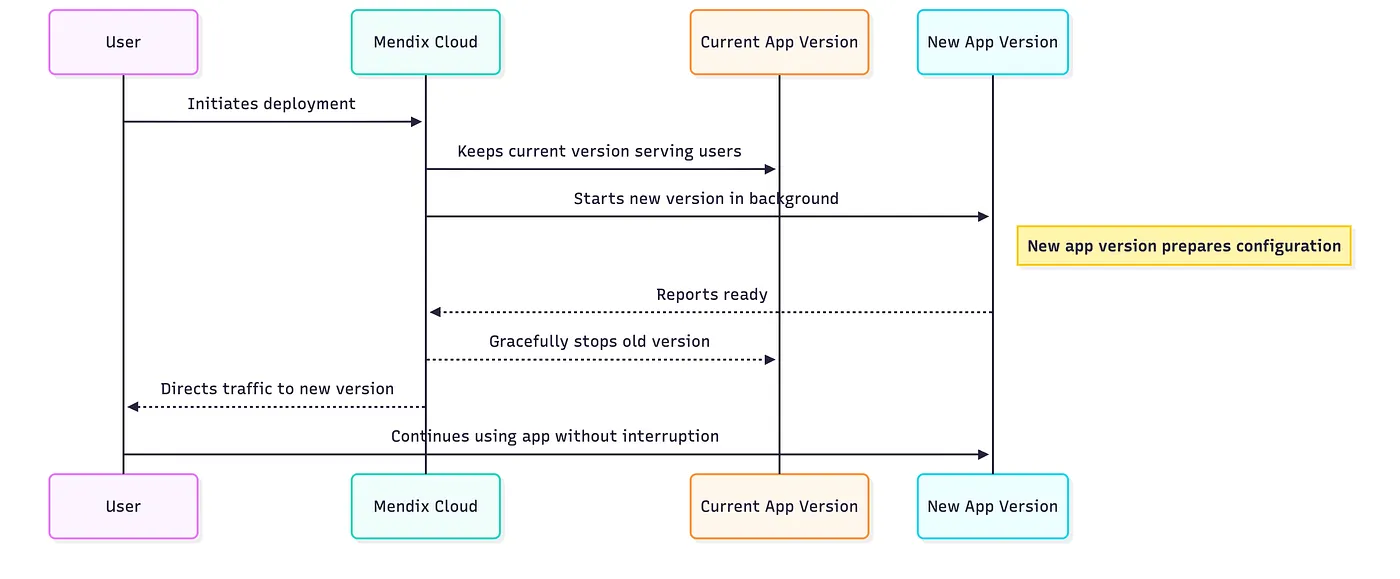
Mendix has finally released a feature which many have been asking for: Zero downtime deployment (or, referred to by Mendix as ZDT). This feature allows new application versions to be deployed without interrupting availability for end users, APIs, or integrations. Instead of stopping and restarting an application, a new version is started in parallel and traffic is switched once it is ready. This feature solves an issue that every Mendix application runs into from time to time: the few minutes of downtime when restarting your application. ZDT does not only fix the problem of downtime, it also removes the need for coordination, communication, and supporting processes around planned outages. No more downtime announcements, restart notifications, or custom user-alert mechanisms. This saves significantly more time and effort than the downtime itself ever cost.
How it works (at a high level)
Zero downtime deployment relies on cloud infrastructure that can temporarily run multiple versions of an application. The new version is deployed and started alongside the existing one, after which traffic is redirected. From a user or API consumer perspective, the application remains available throughout the deployment.
 Current Scope: simple changes only
ZDT is an important step toward more reliable, cloud-native delivery of applications, making Mendix even more reliable for business critical applications which require high uptime. It’s great to see that Mendix is continuously striving for improvement. With improvements like these Mendix is reinforcing their position as a key player in the market Low-Code market. However, we are not quite there yet: the scope of ZDT is still limited.
At this moment, zero downtime deployment in Mendix is limited to simple changes. A couple of examples are restarting environments, updating environment variables or constants, or changing log level settings. ZDT is only available for Mendix version 10.24 and above.
As you can see from these examples, this feature is currently still only available for changes which are made directly through the Mendix cloud. When it comes to other changes like model changes, version upgrades or database changes a regular restart is still necessary.
Why it still adds value
Even with these limitations, zero downtime deployment already provides clear benefits for both development teams and end users:
- Your app and your APIs remain available during deployments, meaning that, next to your own end users, other applications which consume your APIs are not interrupted as well. This means fewer interruptions for the application’s ow end users and those of other applications!
- Small changes can be released during business hours instead of waiting until only few people are online. This may seem small, but is nice added values for development teams!
Upgrading your app to the latest LTS version is always recommended, but ZDT really makes it worth the effort. Especially when your application uses constants to manage settings ZDT can be a lifesaver!
Looking ahead
Mendix has indicated that zero downtime capabilities will be expanded in phases, potentially moving from cloud-only changes toward broader support, including logic, UI or maybe even database-related changes. However, timelines for these next steps are not yet known.
Conclusion
Zero downtime deployment in Mendix is a valuable feature, even in its current, limited form. While it does not yet support database changes, it enables safer and more flexible deployment of small changes and helps teams move closer to continuous delivery for always-on applications. Want to know more about this (or any other) cool Mendix feature? Get in touch with us.



We will help you further!
Replace outdated systems, digitize complex business processes and accelerate innovation.