Blender Kickstart 2026: from AI experiments to scalable impact
3 February 2026 • News
During Blender Kickstart 2026, one question took centre stage, a question that many organisations are currently facing with growing urgency: how do you translate AI from isolated experiments into concrete, manageable and scalable value?
The key conclusion of the afternoon was clear. Real AI value does not come from launching yet another pilot, but from making deliberate strategic choices and building a solid foundation of applications, integration, governance and data. Organisations that invest in this foundation today create the conditions to deploy AI safely, responsibly and at scale tomorrow.
Blender Kickstart 2026 brought vision and practice together. With insights from Fountainheads, Mendix and Workato, complemented by real-world stories from organisations already making these choices, it became clear why successful AI implementation does not start with tools or models, but with direction, focus and a strong foundation.
From this central message, a coherent narrative unfolded throughout the afternoon. Technology is evolving faster than ever, but impact only emerges when organisations approach AI as a strategic challenge rather than a collection of disconnected solutions. This red thread ran through all keynotes and customer cases.
Exploring the future: innovation starts with different questions
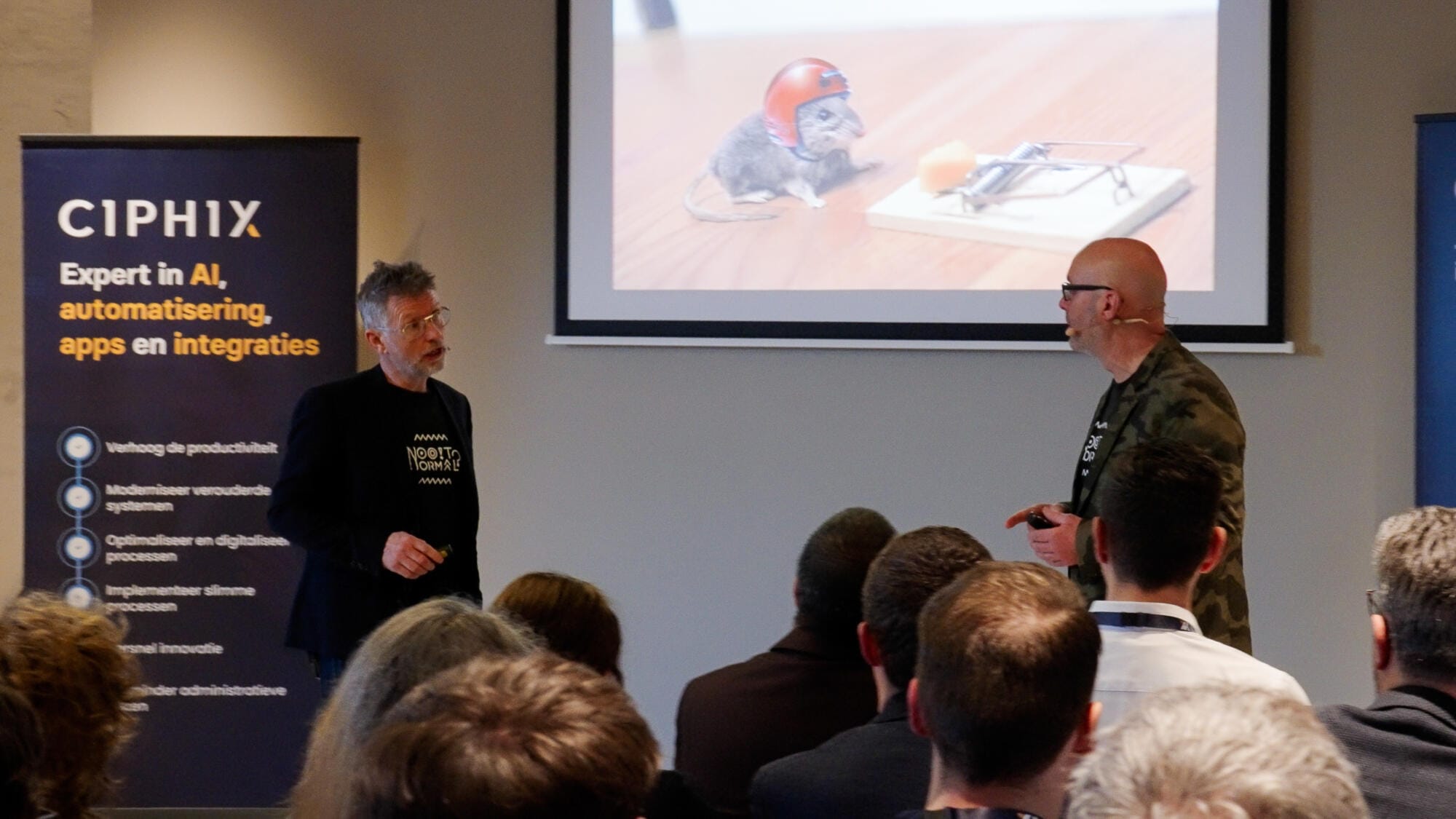
The opening keynote was delivered by trend analysts Jan-Henk Bouman and Wim van Rooijen of Fountainheads. They placed the rapid rise of AI within a broader context of technological and societal transitions. Their central message was that the future is not something you simply predict, but something organisations must actively become more capable of dealing with.
According to Fountainheads, innovation often emerges outside an organisation’s own sector. This is why looking beyond familiar boundaries is essential. Developments tend to appear first at the edges, among new players and in other industries. Using their Trend Exploration Model, they showed how transitions unfold through the interaction of multiple forces, ranging from innovators and investors to activists and established industries.
They also encouraged organisations to rethink how they steer and make decisions. In a world changing at an exponential pace, forecasting based on the past becomes increasingly unreliable. The alternative is backcasting: starting from a desired future state and working backwards to determine which steps are needed today. The keynote concluded with a call to create room for experimentation and, above all, to dare to ask different questions.
For many organisations, this perspective is highly recognisable. AI is therefore not merely a technological development, but a strategic choice. Organisations that fail to define direction today risk being overtaken tomorrow.
AI as a strategic instrument: not faster, but better building
Following this future-focused perspective, Marijn van de Poel, Chief Proposition and Strategy Officer at Ciphix, brought the discussion back to the realities organisations face today.
Many companies are overwhelmed by the sheer number of AI solutions available, while time and budgets remain limited. The question is therefore not whether to do something with AI, but where to start and for what purpose. Van de Poel emphasised that AI is not a goal in itself. Real value only emerges when innovation is tied to strategic ambition, such as increasing revenue, reducing costs or improving customer experience.
He illustrated this with a personal story from a skiing holiday. Two of his sons took ski lessons. One chose speed and bravado when descending the slope, but lacked control. The other took his time and focused on technique, and was ultimately rated best by the instructor. According to Van de Poel, the same principle applies to AI. Organisations can experiment aggressively and roll out tools quickly, but sustainable progress only follows when the right foundations are in place and conscious choices are made about where and how AI is applied.
 Building applications with AI requires governance and guardrails
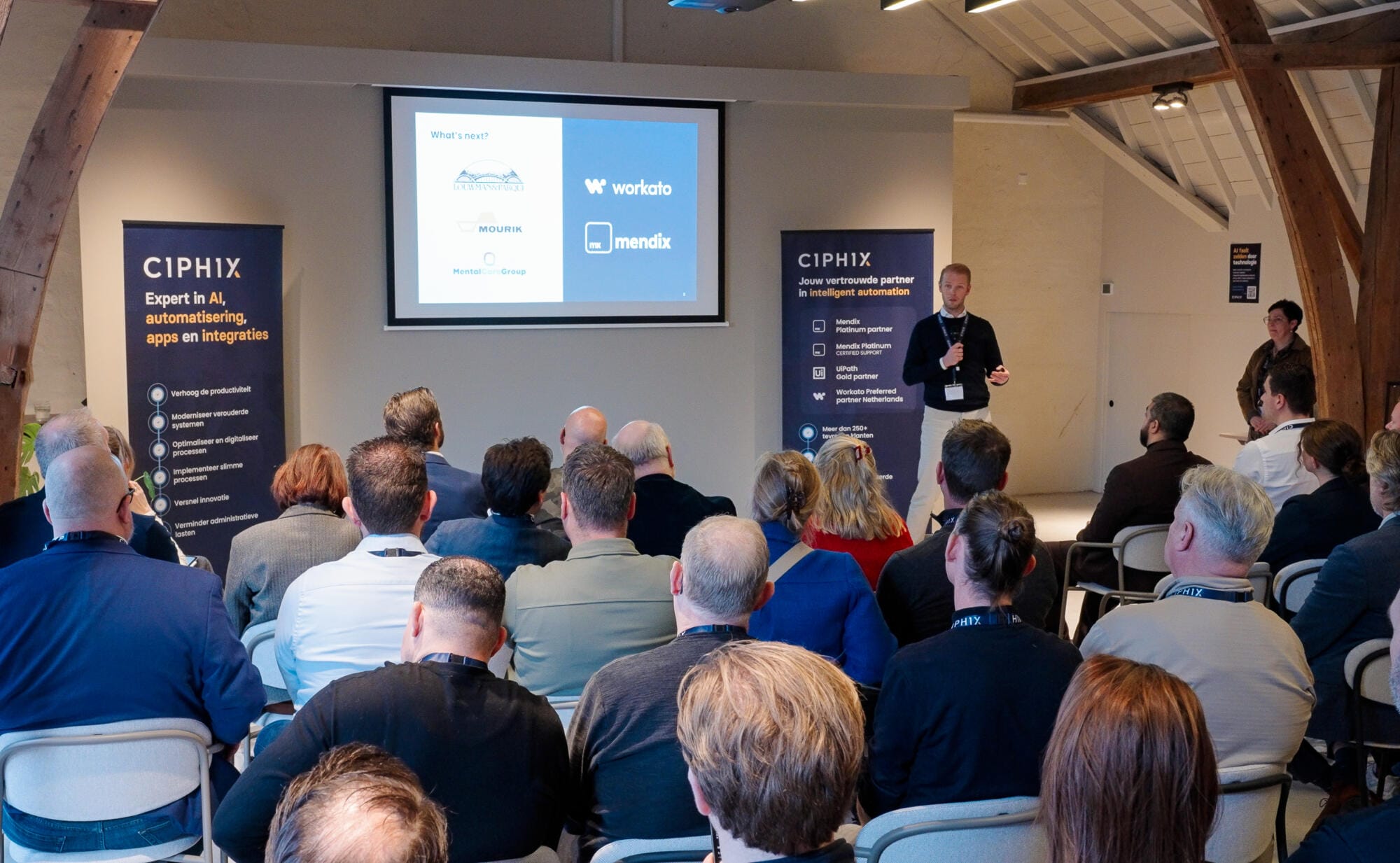
Menno Odijk, Field CTO at Mendix, then addressed the technological challenge in more detail. Why do so many organisations remain stuck in experimentation? According to Odijk, this is not a new problem. Demand for software and innovation has been growing faster than IT departments can deliver for years. AI accelerates development, but it also raises new questions. Development may be faster, but is it better?
Odijk described how software development has evolved from traditional coding to low-code and now to AI-assisted development. The role of the developer is fundamentally changing, from programmer to orchestrator, supported by agents that assist with building and testing.
At the same time, AI-driven software becomes less predictable. Applications are non-deterministic and do not always behave in exactly the same way, because AI makes choices within workflows. This increases the need for governance, traceability and security.
For organisations aiming to scale AI, this is critical. Without clear frameworks and controls, risks quickly increase. Mendix therefore positions itself as a platform where AI is integrated, but always within clearly defined guardrails that ensure control and manageability.
Integration as a key enabler: AI only works when systems are connected
While Mendix focuses on the application layer, Workato addressed another crucial prerequisite for successful AI adoption: integration. Mike Kiersey, VP Global Solution Consulting at Workato, emphasised that AI ambitions can only be realised when organisations are able to properly connect their data and applications.
Many organisations operate hundreds of systems in which information is fragmented. Without coherent data flows, AI initiatives remain isolated experiments. As Kiersey put it, “rubbish in is rubbish out”. The quality of AI output is directly determined by the quality and availability of data. Integration is therefore not a technical detail, but a strategic foundation.
His message was clear. AI requires solid foundations. You cannot build on sand. Integration and data form the basis for sustainable innovation. Workato positions itself as the digital glue and nervous system of the organisation, bringing together integration, automation and governance.
Kiersey also warned against what he referred to as “pilot purgatory”: organisations that continuously test AI use cases but never make the leap to scalable impact. The challenge is not to build one smart solution, but to enable an organisation to reliably roll out ten or fifteen of them over time.
 Customer cases: AI beyond theory
In the second part of the afternoon, theory was reinforced with practical stories from organisations that are already laying the right foundations.
Louwman & Parqui: value starts with asking the right question
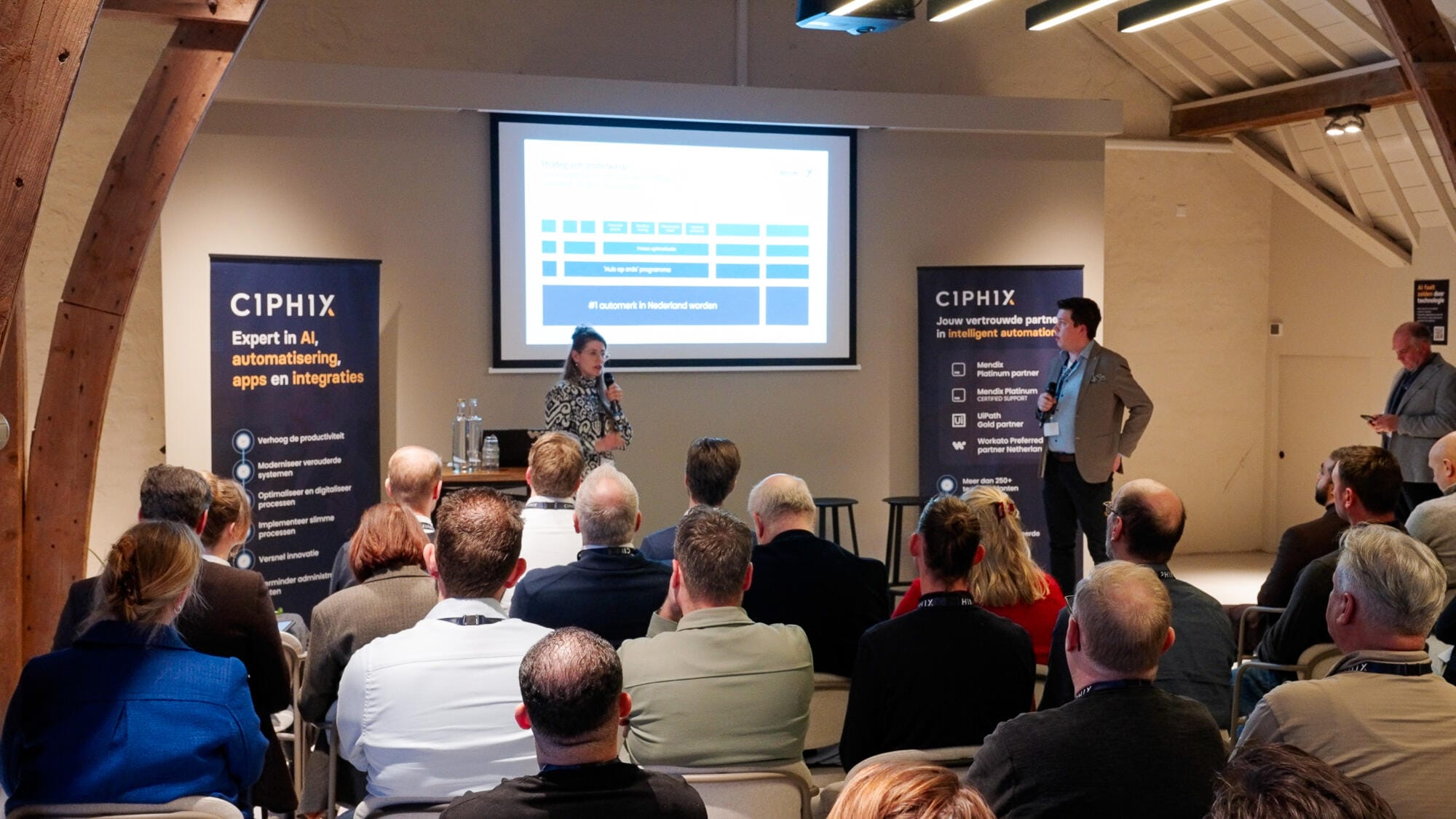
In conversation with Lucia Haagsman, Consultancy Practice Lead at Ciphix, Jeroen van den Berg, Process and Change Consultant at Louwman & Parqui, explained how the organisation approaches digitalisation from a process-value perspective rather than from IT.
Louwman & Parqui is the importer of Toyota and Lexus in the Netherlands and is responsible for marketing, sales and service. The organisation operates in a sector undergoing significant change due to electrification, new regulations and increasing competition. At the same time, ambitions remain high: growing volumes and improving customer satisfaction without automatically adding capacity.
This pressure led to the launch of the multi-year improvement programme Huis op Orde. Together with Ciphix, Louwman initiated a broad opportunity scan, visiting fifteen departments and running workshops to identify bottlenecks and future ambitions.
The result was a backlog of more than one hundred improvement opportunities, ranging from small quick wins to larger digital initiatives. Van den Berg stressed that the strength of the approach lay in its business-driven nature. It was explicitly not an IT-driven exercise, but a programme centred on operations and strategic objectives.
Notably, value did not always lie in technology. In some cases, simple process changes already delivered significant impact. At the same time, a roadmap is now being developed in which initiatives are assessed based on impact and effort, with a Sprint 0 phase to properly explore opportunities before building solutions.
The key lesson from this case is that digital transformation is not about building faster, but about building the right things.
Mourik: predictability and risk control in industry
Bart Poelmans, Mendix Practice Lead at Ciphix, spoke with Geert Janssens, CISO and Enterprise Architect at Mourik, about digitalisation in a sector often seen as traditional, yet characterised by high operational complexity.
Mourik is a diversified family-owned company active in construction, infrastructure and industry. Janssens explained that their core challenge revolves around logistics and precision. The right people, equipment and expertise must be in the right place at exactly the right time, often in environments where delays directly translate into financial loss.
Digitalisation is therefore not merely an efficiency exercise, but a way to increase predictability and control. When projects run late, the consequences for clients can be severe. Janssens gave the example of refineries that cannot restart operations if a project is delayed, resulting in immediate financial impact.
Together with Ciphix, Mourik developed the Opera application to further automate the order-to-cash process (see the case). While this may appear to be a back-office step on paper, it has direct consequences in the field, including better planning, increased reliability for customers and reduced operational risk.
Integration is also becoming increasingly important. As Mourik grows and acquires other companies, its application landscape becomes more fragmented. Workato has been included as an integration layer within the reference architecture to connect legacy systems with a new data management platform. This enables Mourik to move from isolated silos to a coherent digital foundation.
In the context of AI, Janssens sees a clear distinction. Generic business AI is widely available, but the real challenge lies in use cases that deliver direct business value. His advice is to organise innovation along two tracks: a fast track where experimentation is encouraged, and a governance track where solutions are safely and scalably embedded within architecture and controls.
This case demonstrates that AI and digitalisation are a strategic necessity even in traditional sectors, enabling organisations to remain agile and manage risk effectively.
Mental Care Group: digitalisation driven by societal pressure
The final customer story highlighted that AI and digitalisation are not only about efficiency, but can also address pressing societal challenges.
Peter Kuiters, IT Director at Mental Care Group, described how waiting lists in mental healthcare are putting pressure on the current care model. Digitalisation is needed to empower clients and make better use of available treatment capacity.
A key accelerator in their digital journey was a moment of urgency. The supplier of the existing client portal announced it would discontinue the product. Mental Care Group (see the case) was faced with a choice: move to another standard platform or take control by building a solution aligned with its own vision of digital care.
The organisation deliberately chose the latter. Not only to avoid vendor lock-in, but to maintain speed, flexibility and ownership in a domain characterised by complex processes and regulations. After a rapid selection process, Mendix was chosen, enabling Mental Care Group to build a new portal within nine months, including functionalities that were previously not possible.
As a result, digitalisation became more than an IT project. It became a strategic instrument to organise care differently and to retain control over innovation.
Beyond pilots: foundation, focus and responsibility
Blender Kickstart 2026 demonstrated that the transition from experimentation to impact is not primarily a technological challenge, but an organisational and strategic one. The message of the day was clear. Organisations that want AI to truly deliver value must look beyond pilots and invest in the foundations that enable scalable innovation.
If this challenge resonates, now is the time to start the conversation about direction, priorities and underlying architecture. Ciphix supports organisations with strategy, application development and integration to bring AI safely and controllably into production.
Curious to explore how your organisation can move beyond AI pilots and translate ambition into scalable impact? Get in touch to discuss the possibilities.



We will help you further!
Replace outdated systems, digitize complex business processes and accelerate innovation.